Plain limits
A Finish Date what a page will not pretend
A page here explains a pattern about a cleanup that ends on a named day. It does not already know your balance. Read it as a pattern, then bring your own month to the call.
What a page on this site may say
Each page is trying to answer one practical question. What has to be true, on the day we name, before the word current is allowed. The subjects are ordinary. A bank statement. A card statement. A loan balance. A clearing bucket. A check that never cleared. Owner cash that landed in the operating account. A year that already went to the government. A yearly report some states ask for while the months are still open. The number in your own file, the fee, and a result borrowed from another company do not belong on a public page.
Figures that move when the instructions change stay in those instructions. If a published cutoff would change who receives a January form, the page describes the shape and leaves the cutoff where the instructions print it. A remembered round number, a percent that merely feels fair, and a total from a month still open are three common ways to mislead. A public page is the wrong place for any of those three, because each one pretends the file is already on the table.
The shop drawn on the sketch page is invented, and that page says so before the story. The sketch names no client, names no town, and copies no real receipt. Readers are meant to copy the sequence, not a client's year. Blanks stay blank so a sketch cannot be read as a month that closed.
One sentence in the footer explains how the pages are produced. It is not restated on this page in other words. A wrong date is fixed on the page where it showed up. The fix carries its own date, and the old wording comes off rather than remaining next to the new wording.
A page that depends on a form says which form, in plain words, and only when that form was the one in front of us. If nobody published the market number, it does not get a sentence here. A story from a phone call stays off the page too, even with the names removed, because the order of the transfers alone can give a year away.
Every link except the practice home at the bottom of this page points back inside these pages. A reader who only wanted the meaning of current can stop there. The offer itself is a named day, books matched through that day, payroll set up beside the provider you already pay, and a return built from what that day made true.
New bank lines arriving on their own are not a finished month. A folder of statements is not a finished month until each one has been tied and every difference has a name. Pages may repeat that, because the opposite claim is what owners hear all week.
Money moving between an owner and the company is not wages just because it moved, and it is not a sale just because it landed. A loan coming in is not a sale. A transfer between two accounts the same company owns is not a sale. Pages may name those differences. They may not invent the amount.
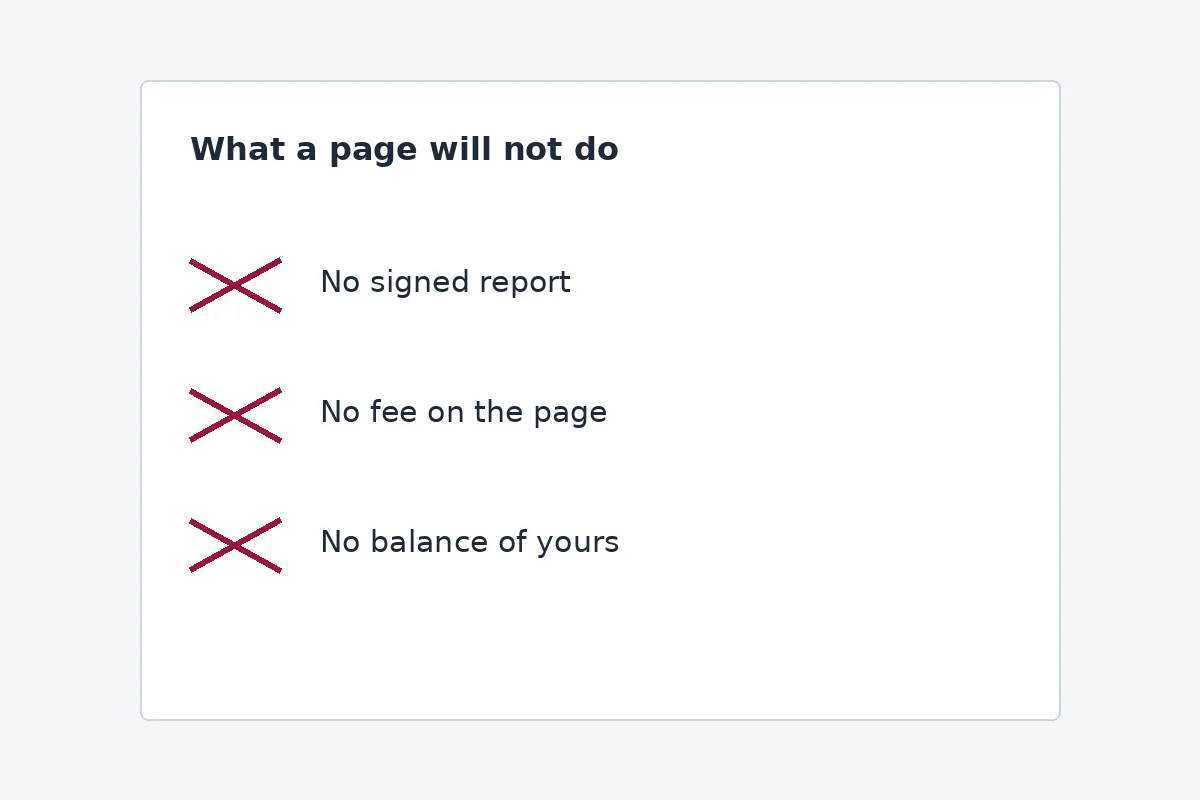
What this practice does not do
The work is the books, the monthly close, payroll set up beside a provider, and the return that follows the named day. No CPA license sits behind the books or the return prepared in this practice. This is not a CPA firm. Lender letters and the three signed report types stay with a firm that is allowed to issue them. Looking up a CPA license for this practice returns nothing, and nobody should read this address as a CPA firm. The books, the close, and the return stay here, and the sentence you are reading is the one that says so. If a contract insists on the signed report, the opening call names a CPA firm and this project stops.
The title certified public accounting firm does not belong on this practice, and the pages will not take it. We will not draft a lookalike of the report a license holder signs. Friday pay stays on whatever calendar that provider already runs. Our part is the setup conversation. Running payday is outside this engagement. We do not sit in an exam or an appeal for you. Records gathered for the cleanup can support a reply to a notice. Whoever attends the exam is the professional whose job that meeting is.
A return waits until the bank and the books agree on the months it uses. That limit is spoken on the first call, ahead of any signature. A stream of new bank lines is only a stream. It is not a month anyone can lean on, including us.
Silence does not pull the following month into the day. Silence does not reopen a year already filed. Silence does not finish a yearly report a state may want. Each of those needs its own written yes, or it stays off the day.
Who answers
Services on this site are provided by Steven Palmieri, Dallas, Texas. Call +1 844-324-7273. You do not have to go looking for the phone. It is printed under the page you are already on. The named day and the return that can use it stay in one practice, instead of being passed between two shops that never read each other's file.
Nothing in the markup adds a street or a mailbox that the rendered page hides. The name, the phone, and the web address are the whole public identity.
These pages are for an owner who wants a cleanup with an ending. Other work this practice does has its own page on the practice home. The one way off these pages is stevenpalmieri.com. Stop on that site.
Submissions stay with the practice that keeps the named day, and they are not forwarded to anyone else. Sending that note is not a hire, and the fee is not written into it. Talking does not hire anyone, and no price exists until a signed scope states the fee. A call can also end because the honest finding is that the months are few and already matched, so the service is not needed.
If two people own the company, both can join the same call. We will not choose a side, and we will not hide a transfer from one of you because the other asked. Bring a lawyer if you want one. That hire is yours, and we name the split before the call starts.