The word
A Finish Date what current means on that day
Someone called the books current, and could not name the month. Current is a word vendors use when they cannot say which month. Here it means a list you could check.
The bank meets the books
On the named day, the statement ending and the balance in the books are reconciled. The difference, if there is one, is a list of items that have names. Outstanding deposits. Checks not yet cleared. A bank error with a date. Not a plug, and not a shrug.
A live feed of new transactions is not this tie. The feed is a delivery mechanism. The tie is a person agreeing that the two balances tell one story. Until that agreement exists, the month is open, however busy the coding has been.
Cards, loans, and the buckets that should be empty
Card statements get the same treatment as the bank. So do loans. A balance sheet account with no statement behind it is a rumor. On the named day the rumor has a document, or the account is flagged as still open and the day does not pretend otherwise.
Clearing buckets and temporary parking spots are empty, or each leftover item is written down with the question it is waiting on. Those buckets are how a cleanup stays honest. They are also how a cleanup hides, if nobody looks at them on the last day.
Items that are not income stay not income
Owner money coming in, loan proceeds, and transfers between the company's own accounts are labeled as what they are. Calling them sales makes the year look stronger and makes every later report a little more false. Current includes the courage to leave a deposit in the right place.
The mirror image matters too. A bill you owe is a bill, even if paying it would make the month look worse. Hiding it below the named day is how the next month starts already behind.
The word is not an opinion on the whole company
Current, on this site, is not a judgment that the business is healthy, and it is not a signed assurance for a lender. It is the list. If the list is true, we will say current and we will say the day. If a line is still open, we will say that line, out loud, and we will not borrow the word.
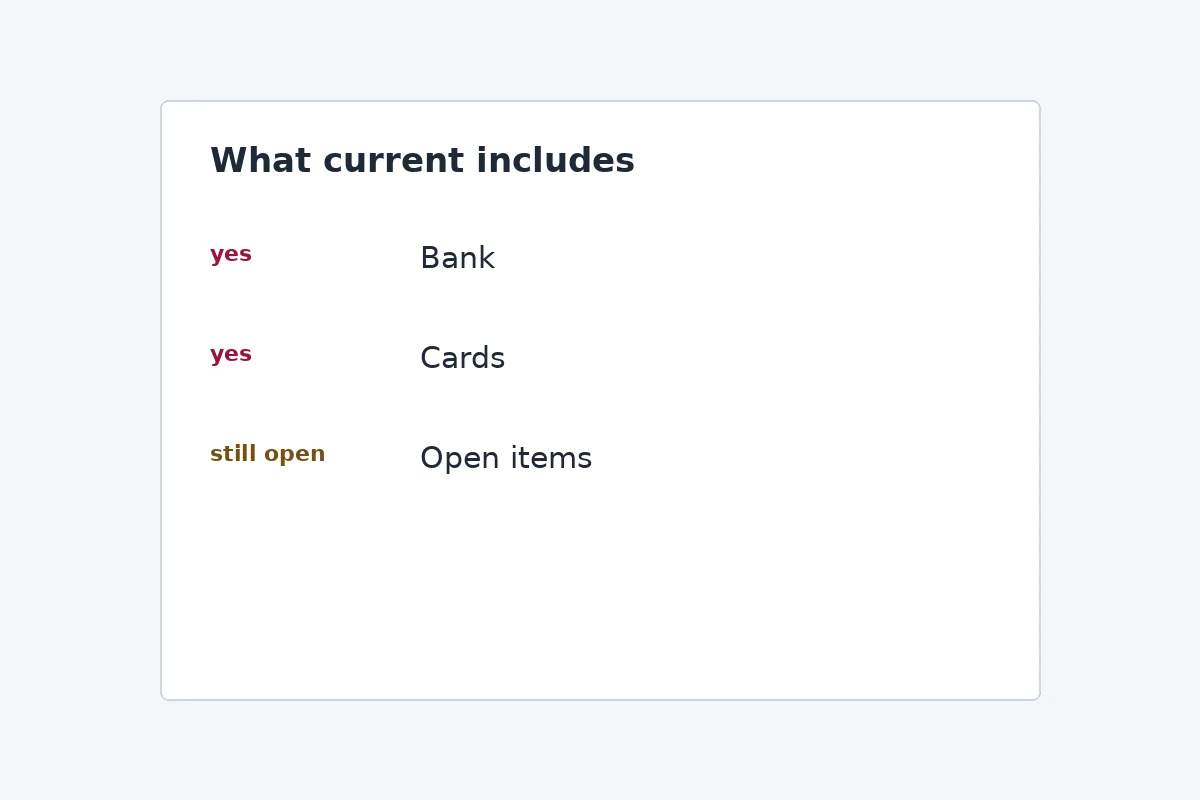
The definition should travel without a speech attached. Bank tied. Cards tied. Open items named or empty. The filed year handled as its own decision. The yearly report handled or named as open. That is the whole word.
The ties we actually run
Bank to the statement. Each card to its statement. Each loan to its statement. Where a statement does not exist, the account is on the open list, and the day does not step over it. A tie means the ending balances agree and the bridge between them is a list of real items.
We do this in the order the money moves. Bank, then cards, then the loans and the lines. Owner transfers come after the accounts exist to receive them, not before, or they land in a pile called miscellaneous and stay there.
A lender's email that asks for statements is asking for this tie, even when the email uses a softer word. If the tie is not done, we do not send a package that pretends it is. The oldest open month on the calendar is the start of the tie, not the month that happens to be in the subject line.
Buckets, and checks that never cleared
A temporary account used to park an unknown item is a tool, not a home. On the day, it is empty, or every item left in it has a question written next to it and a person who owes the answer. An empty-looking bucket that still has a balance is not empty.
A check that has been outstanding for a long time is a decision. Void, reissue, or keep, with a reason. Leaving it because it has always been there is how reconciliations grow a beard. The beard is not a control. It is a postponement. The page on uncleared checks is where that decision gets its own method, including the holding account the team uses when the cash is still in the bank and the expense was already recorded.
The names of the deposits
Every deposit that is not a customer payment gets its real name. Owner money in. Loan in. A transfer from another account of the same company. A refund. If we cannot tell, it stays a question, and the question is visible. It does not become sales for the sake of a clean profit report.
Customer payments that are real still have to match an invoice or a reason. A payment applied to the wrong open item makes the next month's collections story false. The day includes that match, or it includes the unmatched list.
The sentence at the bottom
Under the ties and the names, one sentence. We call the books current as of this day, or we do not, and here is the line that stopped us. You should be able to read that sentence to a preparer without adding a speech.
If a condition on this page is impossible for your file, the engagement should already have moved it to the open list or to the outside list. Discovering it on the afternoon of the day means the paper was thin. We would rather thicken the paper at the start.
You leave that afternoon holding the sentence, the list, and a copy you can show without logging in. New transactions tomorrow do not erase it. They start the next month, which is a different yes if you want it.
Tick it before the call
You should be able to take this page to the oldest open month and tick it yourself before we ever open the file. Start with the bank. If the statement ending and the book balance do not meet, write the difference as items with names, or write that you do not know the items yet. Do the same for each card and each loan.
Then look at the buckets. A balance with no statement and no name is still open. Then look at deposits that are not customer payments and give each one its real name, or leave it as a question. Then write the one sentence. Current as of a day you can point to, or not current, and here is the line.
If you cannot write the sentence, the day you hoped for is still a wish, and the wish is useful only because it tells us where to start. Bring that sheet to the call. We would rather begin from your own tick marks than from a mood someone else awarded the file.
What the afternoon writes down
The afternoon of the named day writes the date, the accounts that were tied, and the statement dates they were tied to. It writes the items still open, each with a name. It writes the decision on a year already filed, the decision on a yearly report, and one sentence in ordinary words about whether we will call the books current.
If we will not call them current, the afternoon still produces that page. It names what is left. A day that appears only when the news is good is a marketing day, not a bookkeeping day.
A page you can hand to someone
A preparer, a lender, or a future you should see that page and know where the truth starts. Not a login. Not a dashboard mark the software awarded itself. A page a person will stand behind, with the date on it.
We keep a copy. You keep a copy. The copy is the end of the project. After it, a change is new work. You should be able to show the page without opening the software.
When the quiet does not come
The afternoon can feel quiet, or a little hard to believe, when the open-ended version lasted a long time. A bill you had been avoiding may show up once it is no longer mixed into the mystery. That is part of the relief. The mystery had been hiding the bill.
If the feeling is panic, the list was wrong and something that mattered was missed. Say so the same week. A day that cannot survive a question was not the day. New transactions the next morning do not unwrite it. Treating every new transaction as a reason to reopen the prior close means the close was never a close.
Keep reading
Ask what current would include.
I want current to mean a day, not a feeling.
 You will be talking to the Steven Palmieri practice.