Old checks
A Finish Date uncleared checks on the named day
A check left the books months ago and never left the bank. The named day cannot pretend that check is a mystery forever.
What the holding account is
The team keeps an Other Current Liability account named Uncleared Checks. It is for a payment that is on the books while the money never left the bank, most often a paper check that was written, recorded, and then never cashed. The worked example on this page is not a client file. Amounts stay blank on purpose.
The journal entry, dated in the period being reconciled, debits the bank and credits Uncleared Checks for that amount. In the reconciliation, both the original check and this journal entry are ticked, so they cancel and the reconciliation can reach zero. The cash really is still in the bank. The obligation stays on the balance sheet, named. The profit and loss is untouched, because the original expense stays where it was posted.
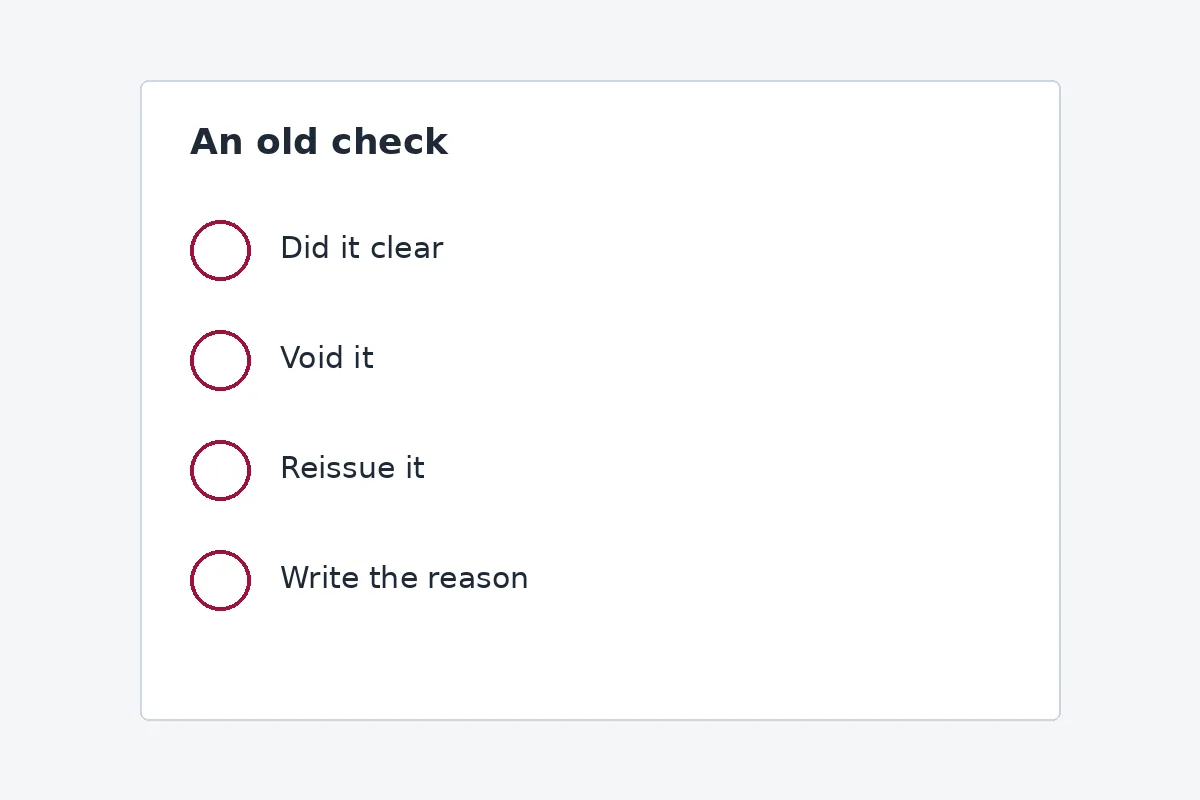
The balance in that account is not a plug and not an error. It is payments recorded and expensed that the payee has not taken yet. On the named day the account is either empty or every line in it has a name and a next step.
Why not leave the check outstanding
A reconciliation can leave a check unticked. Statement balance minus outstanding checks equals the book balance, and nothing is wrong with that. The trade is where the obligation shows, and whether every future reconciliation has to look at the same stale line.
Leave it outstanding and the book cash sits lower than the bank statement by that amount. The obligation is only implied by an unticked item. The stale line reappears in the list forever, and years later someone can tick it by accident. Move it to Uncleared Checks and the book cash agrees with the statement. The obligation is on the balance sheet where a reader can see it. The reconciliation list stays clean. The new risk is that the account itself goes stale if nobody reviews it. That review is the part that must not be skipped. A balance with no owner becomes a fixture nobody can explain.
The payroll case, still not a client file
A paper paycheck makes this more often than an ordinary bill does. The paycheck is in the books, and nothing hits the bank until the person cashes it, so there is no bank-feed line to match. A direct deposit does appear in the feed. An uncashed paper paycheck can sit outstanding, quietly, in every reconciliation until someone deals with it.
The payroll taxes are often paid anyway. The wages may already be on the filed payroll forms and on the wage statement. The person has been taxed on money they have not received. Only the net pay is stuck. Once that quarter is filed, do not void the paycheck to make the reconciliation look tidy. Voiding rewrites payroll history and puts the books at odds with forms that already went in. The repair then becomes a corrected filing, which is a different project from a cleanup. Use a stop payment on the paper check and reissue, which is the route below.
How the balance clears
The rule is short. The clearing payment hits the liability, never the original expense account again. Coding the replacement to wages, or to whatever the first entry expensed, counts the deduction twice and leaves the liability standing.
Three routes, and none of them touch profit. If the payee cashes the original check, the bank debit is matched by debiting Uncleared Checks and crediting the bank, the mirror of the first entry. Tick that against the statement line in the month it clears. If a replacement is issued, stop payment on the old one, then write an ordinary check coded directly to Uncleared Checks. Same entry as the first route. No new payroll run, and no new expense. If the payee gives it up, an owner or shareholder can move it to an equity contribution, because it is capital, not income. For a third party, do not simply take it to income. An uncashed payroll or vendor check is often unclaimed property under that state's rule, so look the rule up before anything is written off.
On a cash-basis return the original expense was often deducted when the check was written, even though the cash had not moved. Clearing the liability later does not deduct it again, and it does not put the deduction back. The named day records which route each line is on. A line with no route is still open, and the day says so.
Keep reading
Tell us about a check that never cleared.
An old check is still open, and I want it decided on the named day.
 You will be talking to the Steven Palmieri practice.