Your own money
A Finish Date owner pay left on its own line
Money left the company for the household, and the books called it a sale. During a catch-up it is tempting to tidy the owner's money into whatever category makes the year look normal. That tidy is often a lie.
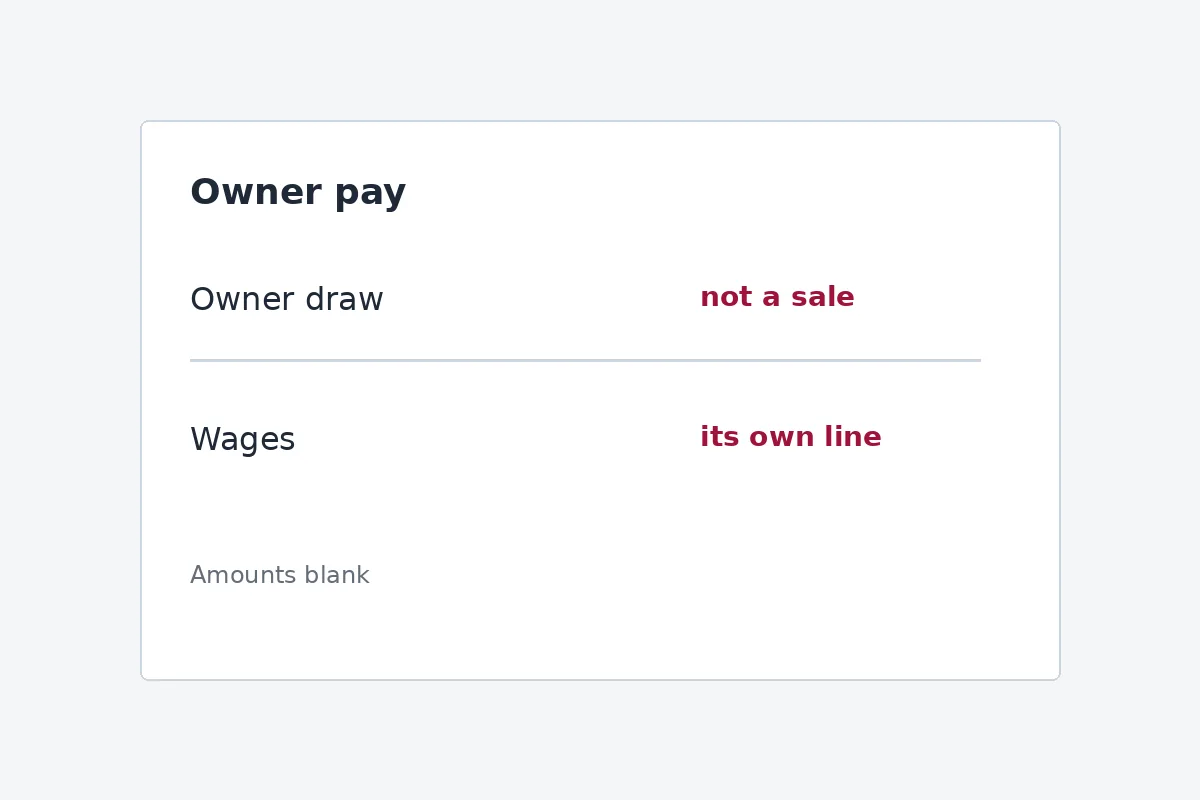
A draw is not a wage by hope
Money you move from the company to yourself might be a draw, a distribution, a repayment of what you put in, or a wage. Those are different events. They hit different reports. A cleanup that picks the one that makes profit look right, without a decision, has edited your year.
We leave owner pay where it is unless the paper says we are deciding the question. Left alone means the transfers stay visible and labeled as what the bank shows, until you and we agree they are something else.
When wages are actually the answer
Sometimes the owner should be on payroll. The company has been paying the owner like an employee in every way except the form. In that case the fix is a setup conversation with the provider who will run payday, not a journal entry that invents a year of wages in December.
Setup means the accounts, the filings, and a clear start date. The provider still runs payday after that setup conversation. The provider's calendar stays payday. Our day stays the day the books are matched.
What we will not recode to be helpful
We will not move a year of personal spending into wages to manufacture a deduction story. We will not move it into the opposite direction to manufacture profit for a lender. Both edits feel clever in the hour they are made and expensive when the return or the loan file is read.
Personal spending that truly is personal can be reclassed to equity when the documents say so. That is one of the ordinary endings for an item that was parked because nobody knew what it was. The document comes first. The category comes second.
The list shows the choice
On the named day, owner pay is either unchanged and labeled, or changed and the reason is written. A silent recode is the failure mode. You should be able to see your own money on a report and recognize it.
If you are not sure what the transfers were, say that. Uncertainty is a better starting point than a confident wrong category. The open item is allowed to stay open until the answer exists.
Keep reading
Tell us how you take money out.
I take money out of the company and I do not want it quietly recoded.
 You will be talking to the Steven Palmieri practice.